WHAT IT TAKES TO MAKE XR STICK
For years, immersive technology has been sold to industry and consumers alike on its ability to impress. Put on a headset, step inside a virtual environment, and experience something that a laptop or smartphone simply cannot replicate.
But for Ricky Holm, Founder and CEO of Chocolate Milk & Donuts (CM&D), the real opportunity lies in understanding where immersive technology can solve problems that existing tools cannot, and what organizations need to make those solutions work over time.
Since founding CM&D in 2016, Holm has seen firsthand that developing a compelling XR experience is only part of the challenge. Successful adoption also depends on how the technology is introduced, supported, and integrated into an organization’s everyday operations.
While XR offers capabilities that traditional devices cannot replicate, Holm believes it is most effective when used alongside existing tools rather than as a replacement for them. A laptop can teach someone about a piece of machinery, but a headset can give them the opportunity to practice operating it. Similarly, an immersive simulation can allow new employees to practice responding to a workplace hazard without assuming the real-world risk. The goal is to identify where immersion can improve the way people learn, train, and work.
That approach requires organizations to think beyond the technology itself. They need to understand the problem they’re trying to solve, choose the right tools, and plan for funding and long-term support. Just as importantly, the people expected to use the technology need to understand it and feel comfortable doing so.
A successful XR program may involve students or employees using the technology, educators or trainers administering it, managers measuring whether a program is improving outcomes, and executives deciding whether those results justify continued investment. Each person needs something different from the same deployment. If any one of those pieces is ignored, long-term adoption becomes harder.
Lessons from Wyoming
CM&D put that approach to work through the Wyoming Innovation Partnership. The state had already begun experimenting with immersive technology across its higher education system when CM&D was brought in to help coordinate those efforts into a statewide program.
Rather than starting with new equipment, Holm and CM&D’s director of strategy rented an RV and spent two weeks driving across Wyoming, visiting nine locations and meeting with educators to understand the barriers they faced to adoption.
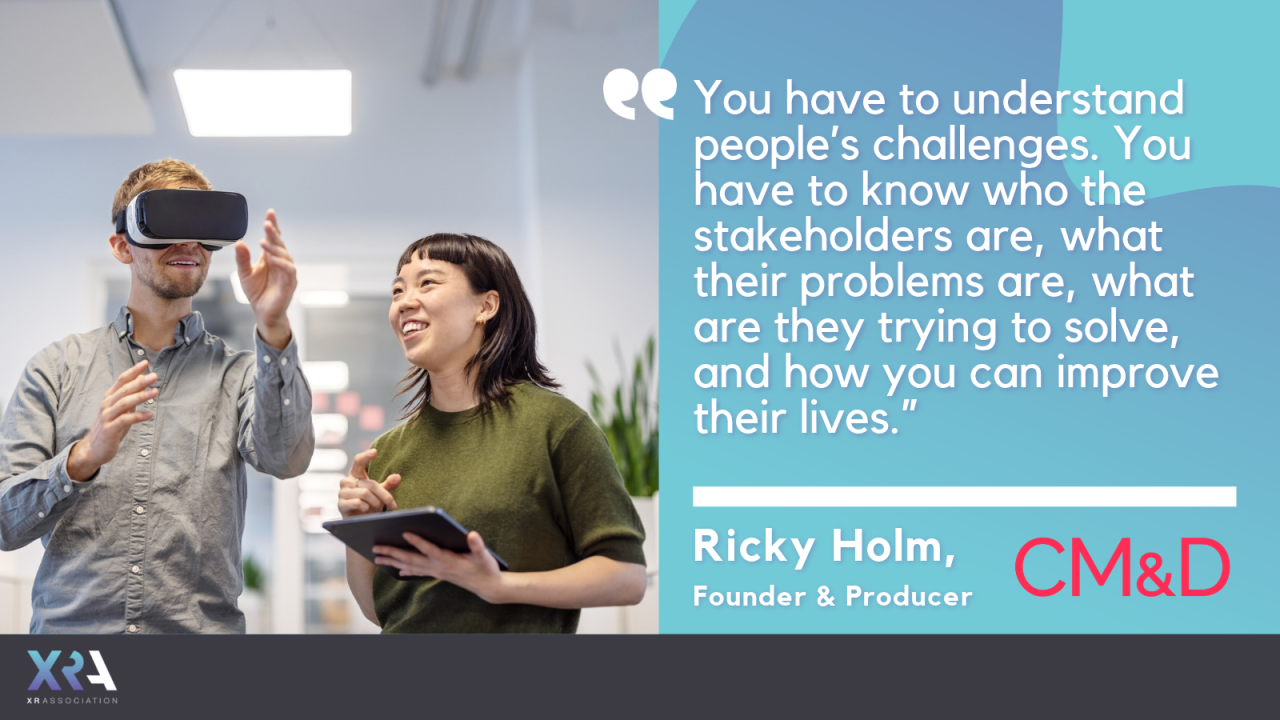
“You have to understand people’s challenges,” Holm explained. “You have to know who the stakeholders are, what their problems are, what are they trying to solve, and how you can improve their lives.”
From those conversations, CM&D began identifying what Holm calls “program champions,” educators and staff willing to become early adopters, experiment with the technology, and help others understand its value. The team also had to connect those ideas with the state’s broader education and workforce goals. CM&D developed a scorecard system to evaluate proposals for immersive projects, creating a process that connected the priorities of educators on the ground with those of the state officials funding the initiative.
Over time, these champions became some of the program’s most important supporters. At one institution, Holm said, a librarian began hosting regular VR gatherings, bringing educators and student volunteers together to experiment with the technology. These gatherings introduced more people to applications they may never have associated with XR, including interview practice and classroom instruction.
For Holm, that kind of internal support is what allows an organization to continue using and expanding an XR program long after the initial deployment. CM&D’s goal is ultimately to help institutions develop the knowledge, resources, and confidence to manage these programs themselves.
Making XR Part of Everyday Operations
“I think the biggest thing is that an organization itself has to start to think about VR as a critical piece of infrastructure,” Holm said.
There was a time when computers occupied their own rooms in schools. Students had to go to the computer lab to access them and learn how they worked. Eventually, computers became part of how nearly every lesson was taught. Holm sees a similar opportunity for XR as institutions find practical ways to incorporate immersive technology into their existing operations.
That doesn’t mean every classroom needs a headset or every worker will spend their day in VR. Immersive technology is not a one-size-fits-all solution, and its value depends on whether it is suited to the task at hand.
This approach is particularly relevant as policymakers consider how immersive technology can support workforce development. The Immersive Technology for the American Workforce Act would establish a competitive grant program supporting immersive technology education and training at community colleges and career and technical education centers.
Holm supports efforts to expand access to XR through public investment, but emphasizes that funding needs to be paired with a clear implementation strategy. Organizations must understand what they want to accomplish, who will be responsible for managing the technology, and how they will evaluate whether it is working.
“Buying a bunch of headsets and software is not the solution,” he said. “You have to understand what problem you’re solving first.”
As more organizations look to adopt XR, the experience itself is only one part of what determines whether a program succeeds. Educators and trainers need to feel comfortable using it, managers need to understand its impact, and leadership needs to see a reason to continue investing.
CM&D’s work in Wyoming demonstrates how thoughtful planning and support can help immersive technology become part of an organization’s regular operations, rather than remaining an isolated pilot. For the broader XR industry, making that transition will be an important part of expanding adoption across education, workforce development, and other sectors.
To learn more about Chocolate Milk & Donuts, visit chocolatemilkdonuts.com.