THE BROWSER THAT COULD UNLOCK THE SPATIAL WEB
In an earlier post, we explored why XR is meant to extend the web, not replace it. This time, the question isn’t how people will experience the spatial web; it’s what will make it possible in the first place.
For years, conversations about the future of the internet have focused on devices. Would virtual reality headsets become a fixture of daily life? Which company would build the hardware that defined the next computing era?
Sean Mann believes the industry’s biggest challenge isn’t hardware at all. It’s infrastructure.
“The PC did not change the world until the web browser gave it access to the World Wide Web,” Mann explains. “The smartphone did not take off until the App Store gave everyone a reason to carry one.” Spatial computing is at that same moment.
Mann is the Co-Founder and CEO of RP1, the company behind a browser designed for the next generation of the web. While much of the XR industry has spent the last several years competing to build better headsets and elaborate, immersive worlds, RP1 has been focused on a less visible—but potentially more foundation—question: How do people actually navigate a three-dimensional internet?
Today’s web works because it has a universal interface. Anyone can type a URL into Chrome, Safari, or Firefox and instantly access information. Websites are owned by the organizations that create them—not by browser companies—and browsers simply provide a window into that content.
Spatial computing, Mann argues, doesn’t have an equivalent.
Instead, immersive experiences remain locked inside individual applications, proprietary platforms, and closed ecosystems. Every new experience often requires another download, another account, another platform.
The model may work for gaming, but isn’t able to scale for everyday life. “No one is going to install a new application every time they walk into a different building,” Mann said.
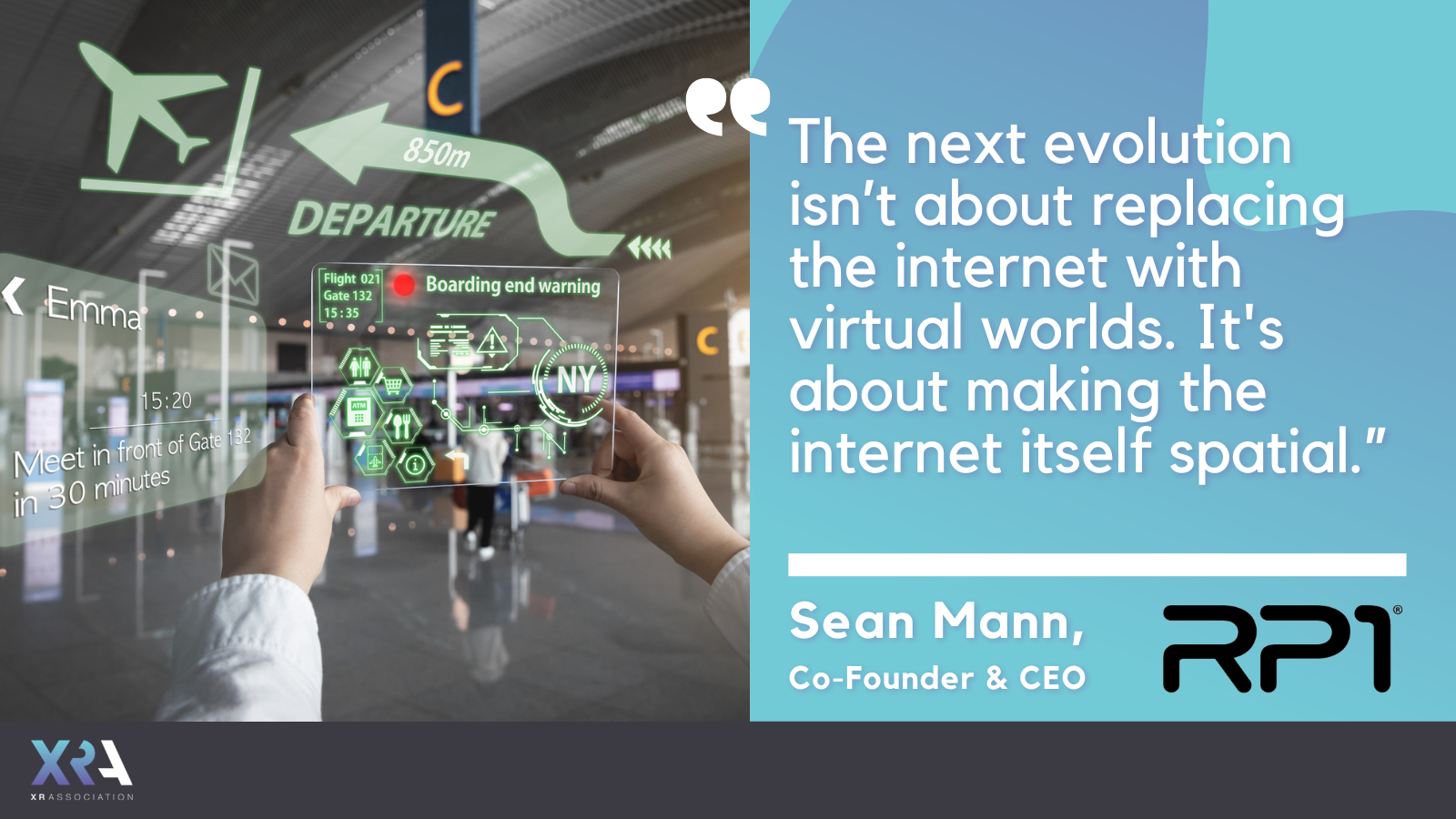
Imagine wearing lightweight AR glasses while walking through the airport. Rather than opening separate apps for flight information, food ordering, navigation, and transportation, relevant digital services simply appear as you move through the terminal. Walk toward your gate and your boarding information is already there. Approach a restaurant and the menu appears. Step outside and transportation options update automatically.
The experience feels less like launching software and more like browsing the web. That’s the future Mann believes spatial computing requires.
Mann’s idea mirrors a phenomenon that has quietly gained momentum across the industry: the next evolution isn’t about replacing the internet with virtual worlds. It’s about making the internet itself spatial.
RP1 has been working alongside the Metaverse Standards Forum through the Open Metaverse Browser initiative, an effort to develop open browser technology specifically for spatial computing. Rather than creating another proprietary platform, the initiative aims to establish shared infrastructure that any browser, hardware manufacturer or developer can build upon. Earlier this year, the group introduced Sneeze, an open-source browser engine designed for spatial computing, but built to handle three-dimensional, location-aware experiences.
This type of innovation will determine whether spatial computing becomes another niche technology or the next platform shift. It’s also a subtle departure from how the metaverse was marketed just a few years ago.
The original vision asked users to leave behind familiar interfaces and spend their time inside fully immersive virtual worlds. Mann’s vision asks something much simpler: keep the web, just make it three-dimensional.
It echoes a broader shift happening across the XR industry. Increasingly, companies aren’t trying to convince consumers to abandon existing behaviors. They’re looking for ways to layer the spatial experiences onto habits people already have—scrolling, searching, shopping, learning, and navigating.
The browser, not the headset, may ultimately become the defining interface of spatial computing. After all, every major computing revolution has had a common gateway: the desktop had the browser, the smartphone had the operating system. The spatial web needs its own.
If that happens, the question won’t be whether people choose to adopt the metaverse. They may simply find themselves browsing it without ever realizing they’ve left the web behind.
To learn more about RP1, visit https://rp1.com/