XRA RELEASES NEW REPORT ON SCALING IMMERSIVE LEARNING IN HIGHER EDUCATION
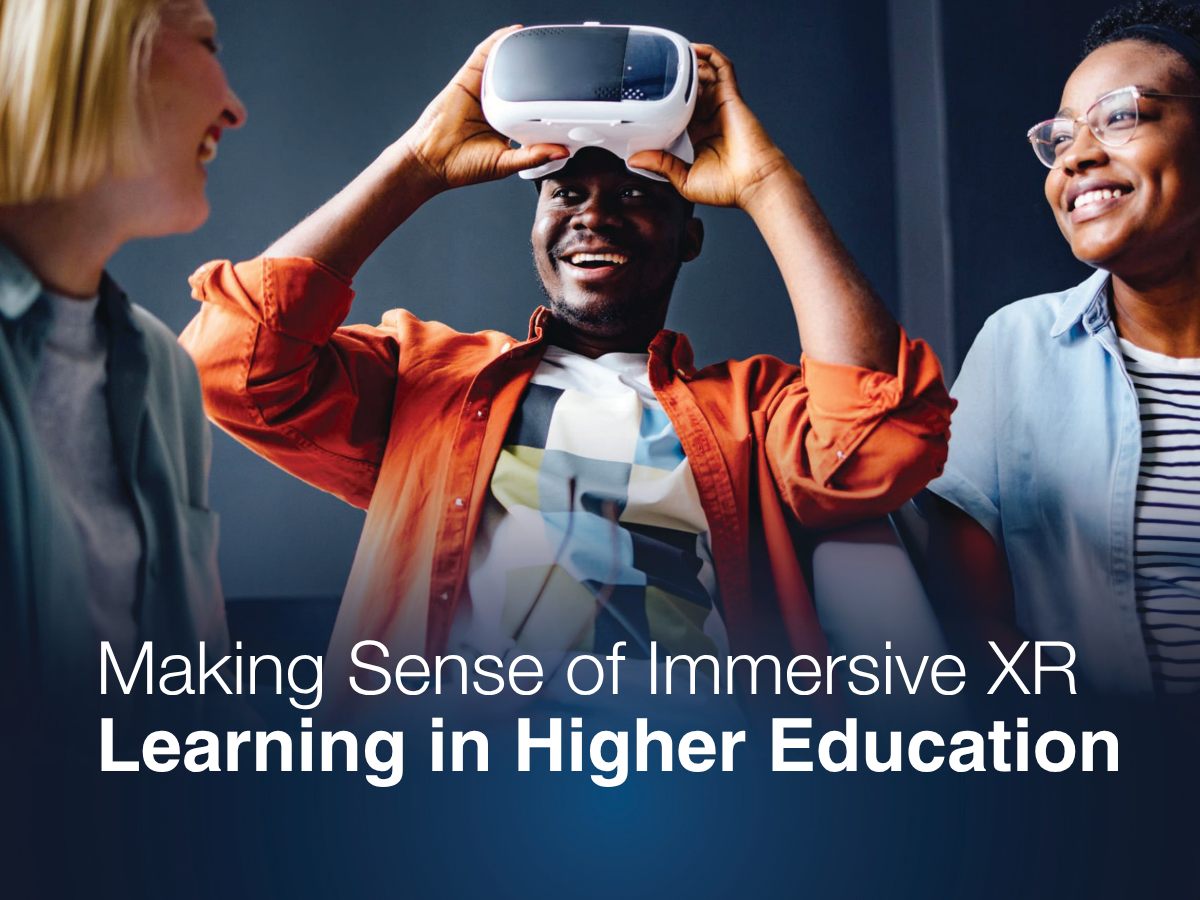
September 22, 2026 – The XR Association (XRA) released a new report today, Making Sense of Immersive XR Learning in Higher Education, examining how colleges and universities can effectively implement and scale immersive learning.
Higher education institutions across the country are deploying XR in various domains. For example, training nursing students in clinical decision-making, preparing learners for skilled trades and hazardous work environments, and providing virtual hands-on experience scenarios that could otherwise be expensive, dangerous, or difficult to replicate in a traditional classroom. These developments come as institutions address labor and workforce shifts, and growing pressure to prepare students for technical careers.
The new report serves as a companion to XRA’s Making Sense of Immersive XR Learning in Secondary Instruction paper, and gives higher education leaders practical guidance for moving beyond individual XR pilots to sustainable, institution-wide implementation.
“Immersive learning is already demonstrating its value across higher education, particularly in areas where students need hands-on experience to prepare for the workforce,” said Stephanie Montgomery, Senior Vice President of Research & Best Practices at the XR Association. “But successful adoption is about more than putting new technology in the classroom. This report gives institutions a practical roadmap for building the training, infrastructure, support, and measurement needed to make immersive learning work at scale.”
Drawing on research, data from XRA member organizations, and lessons from institutions already using immersive technology, the report explores where XR is proving most effective, how institutions can identify the right technology for a particular learning objective, and what is needed to build a sustainable immersive learning ecosystem.
The report also expands upon the DICE framework introduced in the secondary education paper, which helps educators identify learning experiences that are Dangerous, Impossible, Counterproductive, or Expensive to replicate in the real world. For higher education leaders, the report recommends pairing those considerations with three additional questions: whether an XR use case aligns with workforce needs, can scale across programs or student populations, and can demonstrate measurable return on investment.
Evidence from early adopters demonstrates what that approach can look like in practice. A statewide immersive technology initiative in Wyoming delivered 6,625 immersive learning sessions across nine higher education institutions and reached 2,764 students. 98% of faculty who used XR continued using it, and approximately 80% of usage became part of required coursework by the second semester.
“Access to new technology alone isn’t enough. Faculty need hands-on training, ongoing support, and a clear understanding of how XR can fit into the courses they’re already teaching,” said Ricky Holm, Founder & CEO at Chocolate Milk & Donuts. “When that support is in place, adoption has a much better chance of sticking. In Wyoming, 98% of faculty who tried XR continued using it.”
The report identifies five interconnected elements of effective implementation: strategic alignment, shared infrastructure, faculty training and enablement, activation and adoption, and measurement and continuous improvement. It also provides a maturity model to help institutions determine where they are in their XR journey and assess practical next steps for expanding their programs.
Making Sense of Immersive XR Learning in Higher Education builds on XRA’s broader work to help educators and institutions understand when immersive technology can strengthen learning. As the report argues, successful XR adoption requires more than just access to devices.