XR ASSOCIATION PUBLISHES NEW GUIDE ON IMMERSIVE LEARNING IN SECONDARY EDUCATION
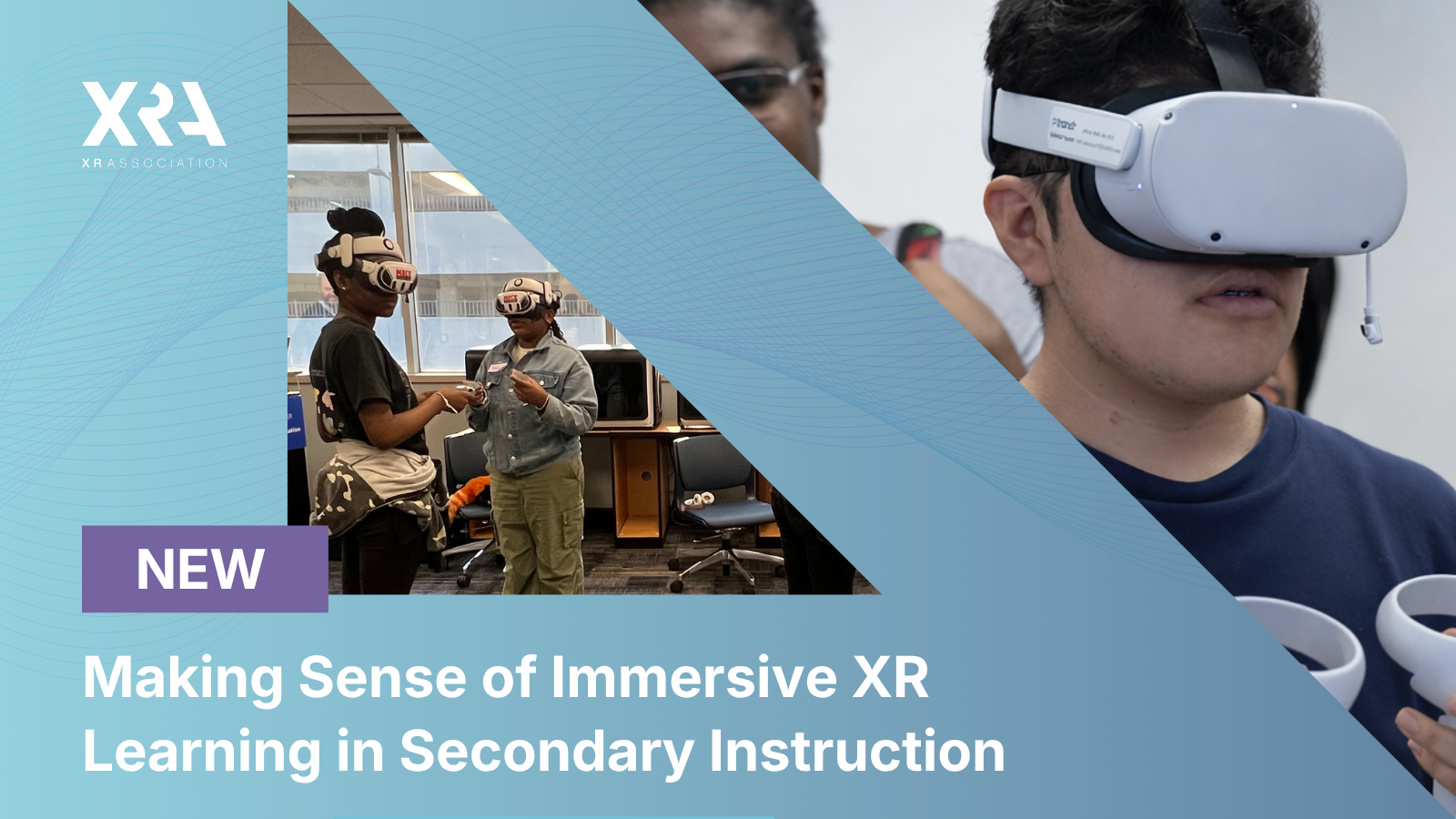
Today, the XR Association released a new document on the role of XR in secondary education. The paper, titled Making Sense of Immersive XR Learning in Secondary Instruction, explores the ways in which XR can be incorporated into classroom environments to support spatial reasoning, disciplinary thinking, academic discourse, and career-connected learning. While many educators are open to implementing these technologies, the paper aims to provide clarity on how to do so efficiently and effectively.
“The XR Association is grateful for the continued engagement and insights from our member companies, which allow us to provide vital industry resources like this primer on XR in secondary education,” said Stephanie Montgomery, Senior Vice President of the XR Association. “As this technology evolves, it is essential that the education field recognizes its full potential; I am pleased to share this research to help educators effectively harness the power of XR.”
XR has great potential to create a more engaging classroom environment and to reinforce and increase the retention of knowledge for students. The research cited in the document suggests that learning is especially effective when the target task requires spatial transformation, relational reasoning, perspective shifts, or understanding interactions within dynamic systems. Immersive tools amplify the effectiveness of the target tasks in the cited research. The possibilities span across disciplines, from visualizing bond angles and molecular geometry in chemistry to analyzing trade routes and territorial changes in history and social studies subjects.
“Great teaching has always been about providing students access to experiences that expand what they can think, do, and say,” said Jonathan Teske, CEO and Founder of ReframeXR. “We wanted to create a more practical, teacher-first document that demonstrates how immersive technology when thoughtfully crafted, becomes one more powerful tool for doing exactly that.”
To help educators identify the most high-impact opportunities for immersive technology, the guide introduces the DICE framework. This tool encourages teachers to utilize XR for experiences that would otherwise be Dangerous, Impossible, Counterproductive, or Expensive to replicate in a traditional setting. By filtering lesson plans through these categories, instructors can ensure they are effectively maximizing the impact of XR ion student learning in their curriculum-based lesson plans.